
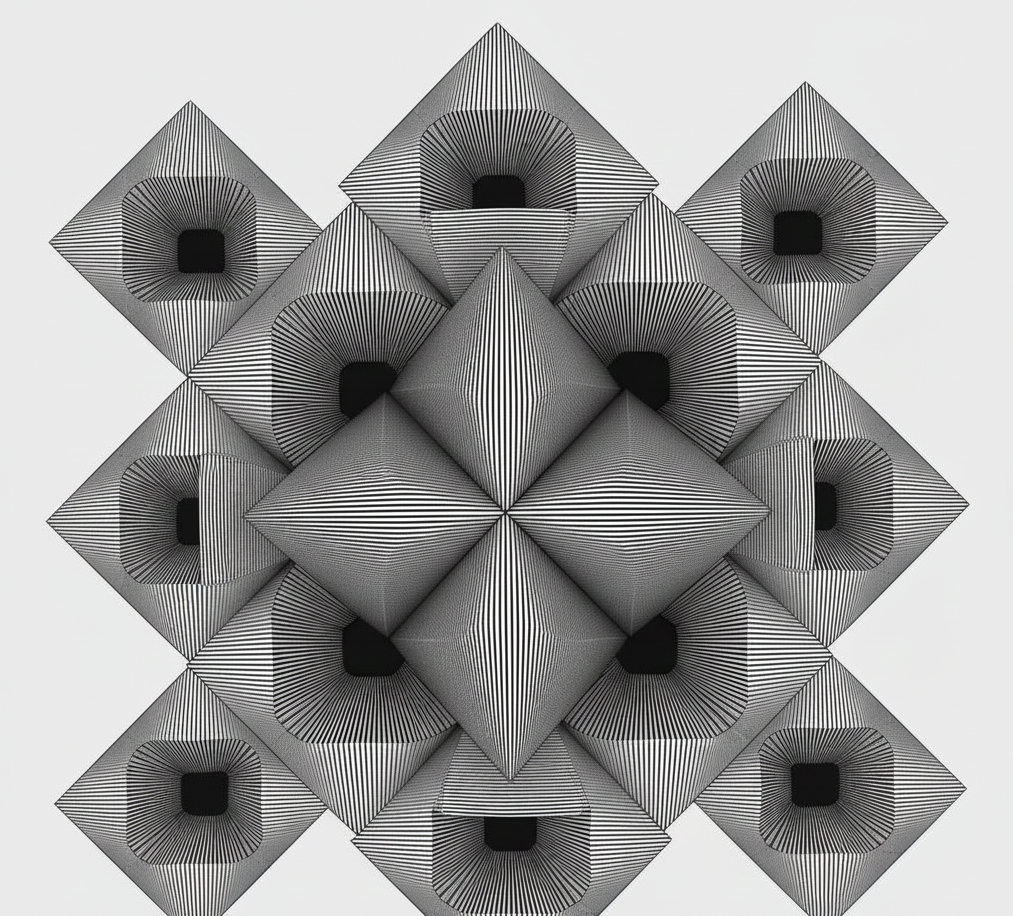
At first glance, you likely see a grid of rectangular panels—like a series of coffered ceilings. But wait… is that all there is? The coffer illusion, created by Anthony Norcia, is a masterclass in perceptual bias. Hidden in plain sight are 16 perfectly circular shapes, waiting for your brain to recognize them. This isn’t just a trick for your eyes—it’s a peek into your brain’s autopilot, showing how prior assumptions can suppress patterns until a Gestalt switch occurs.
Coffer Illusion Explained: Why Your Brain Sees Rectangles First
The Power of Prior Assumption
Your brain has evolved to favor familiar, structured shapes. Rectangles, squares, and grids dominate human-made environments—think tiles, windows, and coffered ceilings. When faced with the coffer illusion, your visual system defaults to the “expected” rectangular pattern, effectively filtering out the circular shapes hiding in plain view. This perceptual bias is why most people initially miss the 16 circles entirely.
Gestalt Principles at Work
Gestalt principles such as closure and grouping dictate how we perceive visual elements as unified wholes. In the coffer illusion, these principles encourage your brain to connect the edges of rectangles, suppressing the round forms in the gaps. Only when your attention shifts—or a Gestalt switch occurs—does the hidden structure of circles emerge.
The Reveal: How to See Circles in Coffer Illusion
Finding the coffer illusion circles is all about altering your perception. Try this step-by-step method:
-
Step Back and Loosen Focus – Don’t stare directly at the rectangles. Relax your gaze slightly to blur the edges.
-
Target the Vertical and Horizontal Gaps – Focus on the spaces between the panels rather than the panels themselves.
-
Look for Symmetry Patterns – The 16 circles are evenly spaced; scanning systematically can help you spot them.
-
Mentally Remove the Rectangles – Pretend the grid isn’t there and visualize smooth, round shapes appearing in the gaps.
-
Practice the Gestalt Switch – Once you detect a few circles, your brain will start to see all 16 without effort.
Following these steps, most viewers experience a sudden “aha” moment when the circles pop into view.
Beyond the Trick: Cultural Influence on the Coffer Illusion
Interestingly, perception of the coffer illusion can vary depending on exposure to urban, “carpentered” environments. Studies show that individuals from highly structured cityscapes are more likely to initially overlook the circles, while those from rural or natural settings may detect the hidden shapes faster. This demonstrates that visual context and learned assumptions deeply influence cognitive processing.
FAQ Section
1. What is the average time to see the circles?
It ranges from a few seconds to a minute or more, depending on your brain’s default focus and familiarity with grid patterns.
2. What is the coffer illusion named after?
The name comes from “coffers,” the recessed, rectangular panels often seen in ceilings, which dominate your initial perception.
3. Can you ‘unsee’ the circles once you find them?
Yes—if you focus again on the rectangles, your brain can revert to the initial perceptual bias.
4. Who created the coffer illusion?
Anthony Norcia, a cognitive scientist and optical illusion researcher, designed this award-winning visual puzzle.
5. How many circles are hidden in the coffer illusion?
There are exactly 16 circles embedded in the grid of rectangles.
The Brain, Not the Eyes, Makes the Illusion
The coffer illusion is a compelling reminder that seeing isn’t believing. Your brain constructs reality based on assumptions, prior experiences, and grouping rules, which can hide information that’s physically present. Once you master the Gestalt switch, you can uncover the 16 hidden circles and marvel at the brain’s hidden machinery.
Share the coffer illusion with friends and watch the fascinating moment their brain finally sees the circles!