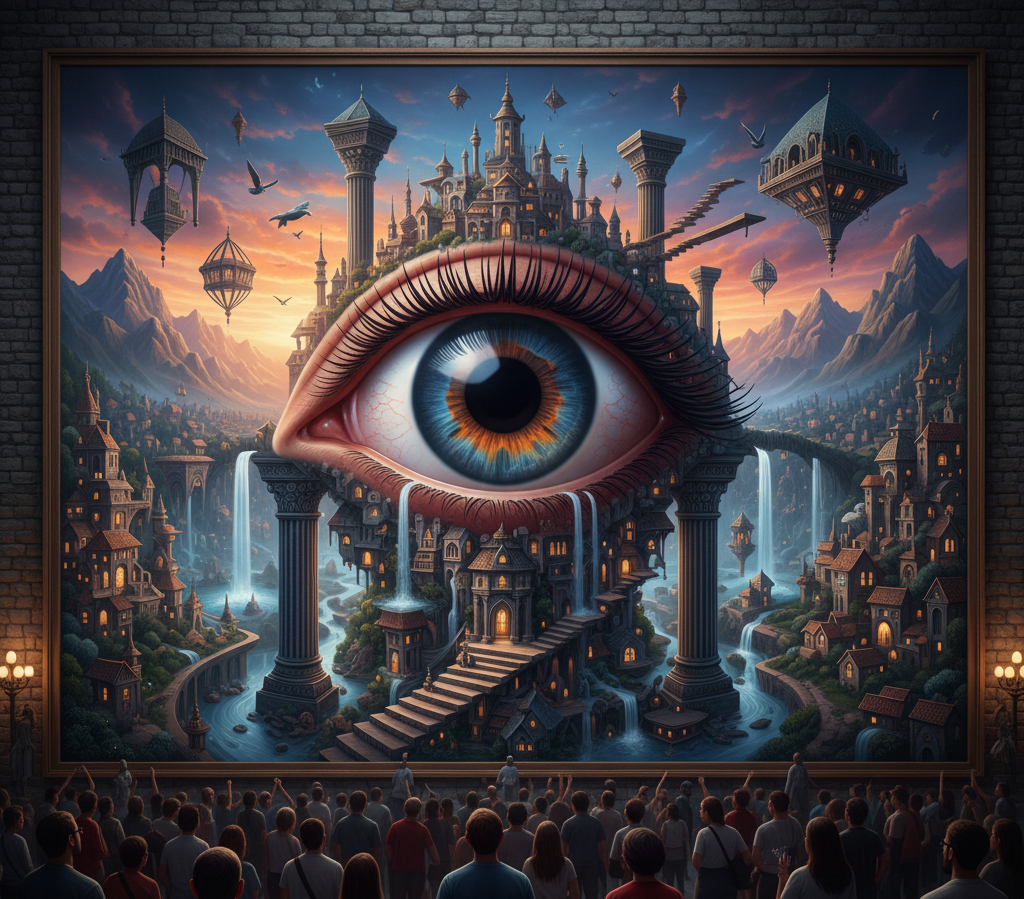
There’s something magical about a piece of illusion art. Whether it’s a mural that seems to extend beyond its frame or a geometric pattern that pulses and moves before your eyes, these works intentionally deceive your perception. Illusion art transforms flat surfaces into three-dimensional or dynamic experiences, challenging the brain and delighting the senses. Today, we explore the masters of visual trickery and offer practical tips so you can try your hand at creating your own optical illusions.
The Masters of Deception: Major Forms of Illusion Art
Illusion art has evolved over centuries, moving from realistic murals to abstract, mind-bending graphics. Here’s a look at its most influential forms.
Trompe-l’œil: The Art of Fooling the Eye
Originating in the French term meaning “deceive the eye,” trompe-l’œil uses precise perspective, shading, and meticulous detail to create astonishingly realistic 3D effects. Classic examples include architectural murals, painted windows, and decorative ceilings where a flat surface appears to extend into space. Artists like Andrea Pozzo and modern muralists have mastered this technique, challenging viewers’ perception of depth and distance.
Op Art (Optical Art): Movement from Static Lines
Emerging in the 1960s, Op Art relies on high-contrast geometric patterns and color interactions to trick the brain into perceiving movement, vibration, or flickering. Artists like Bridget Riley and Victor Vasarely created compositions that seem alive, even though the canvas is entirely static. This is the quintessential optical illusion art—the movement is in your perception, not on the page.
Anamorphosis and 3D Street Art
Anamorphic art plays with extreme perspective to create 3d illusion art on streets, walls, or floors. Sidewalk murals appear to rise from or sink into the ground when viewed from a specific vantage point. Artists like Julian Beever and Edgar Mueller have transformed pavements into waterfalls, chasms, and floating objects, bringing illusion into the real world and inviting viewers to interact physically with the art.
Creating Your Own: Easy Optical Illusion Art for Beginners
You don’t need to be a master painter to experiment with illusion art. Here’s a step by step easy optical illusion art exercise to make a simple floating cube:
-
Draw a Square Base: Use a ruler to create a perfect square on your paper.
-
Add Depth Lines: Extend diagonal lines from each corner, converging at an imaginary point to create perspective.
-
Connect the Vertices: Draw parallel lines to form the back edges of the cube.
-
Shade for 3D Effect: Identify a light source and shade the sides opposite it with gradually darker tones.
-
Refine Edges and Highlights: Use an eraser to create highlights where light would naturally fall.
Voila! A simple illusion of a floating 3D shape emerges on a flat surface. Experiment with circles, stairs, or spirals to expand your skills.
FAQ
Q: What is the difference between Op Art and Kinetic Art?
A: Op Art creates the illusion of movement using static images, while Kinetic Art involves actual physical motion.
Q: What tools do I need for easy optical illusion art?
Basic supplies like pencils, rulers, erasers, colored pencils, and graph paper are enough to start.
Q: Is M.C. Escher considered illusion arts?
Absolutely. Escher’s work, including impossible stairs and infinite loops, is a prime example of illusion and anamorphic concepts.
Q: Where can I see famous Trompe-l’œil murals?
Check European cathedrals, Baroque ceilings, and modern murals in cities worldwide.
Q: Can beginners create 3D street illusions?
Yes, start with chalk on sidewalks and simple perspective grids to practice before attempting complex public installations.
Bring Your Illusions to Life
Illusion art is a playful and profound conversation between the artist and the viewer’s brain. From Trompe-l’œil ceilings to Op Art canvases and 3d illusion art streetscapes, these works reveal the mechanics of perception while sparking creativity. Grab a pencil, some shading tools, and try your hand at creating your own floating shapes or dynamic patterns—it’s easier and more satisfying than you might think!