
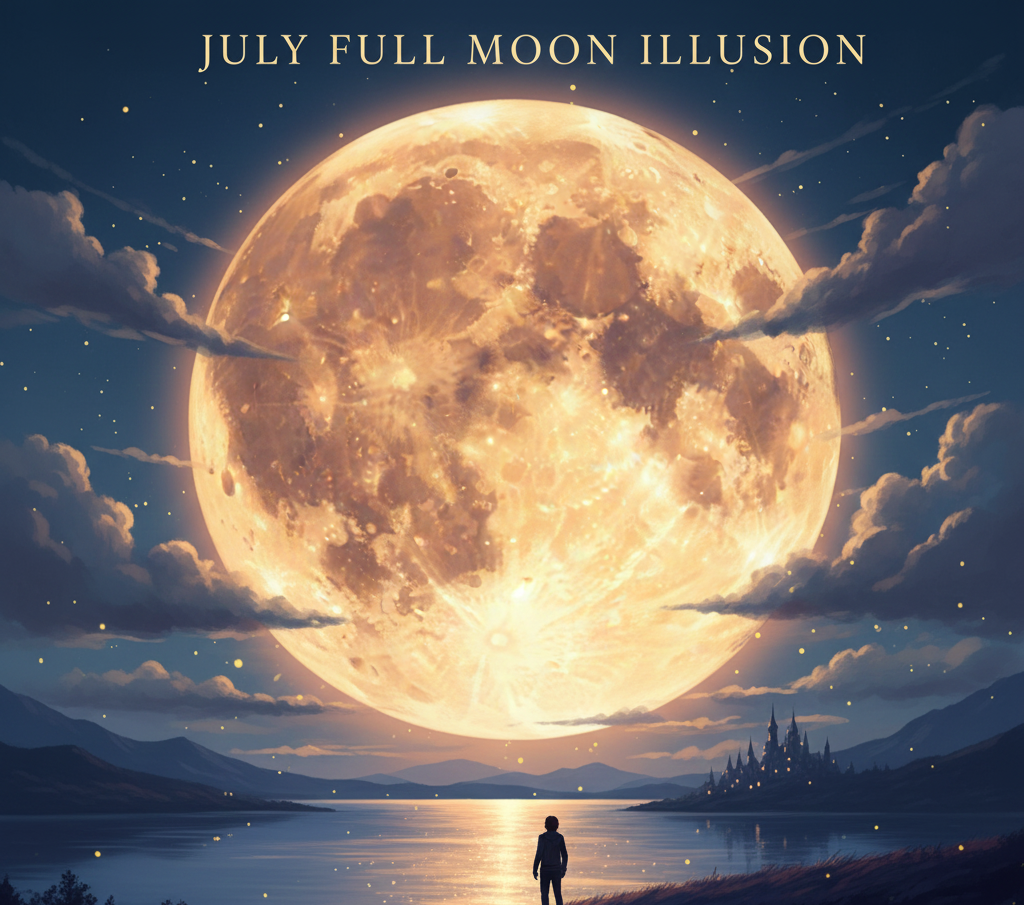
There’s nothing quite like a warm July evening when the Buck Moon or Thunder Moon rises, enormous and golden, hanging low over the horizon. At first glance, it feels almost unreal—like the Moon has grown larger overnight. But here’s the secret: the dramatic size isn’t real. This is the july full moon illusion, a striking example of the classic Moon Illusion. The Moon’s angular size hasn’t changed; what’s happening is entirely in your brain.
The Science of the Trick: Why the Moon’s Size Doesn’t Change
Despite its seemingly massive presence near the horizon, the Moon is just as large as when it floats high overhead. Astronomers measure the angular size of celestial objects to describe how large they appear from Earth, and the Moon’s angular size remains nearly constant at about 0.5 degrees.
Angular Size vs. Perceived Size
Think of holding a coin at arm’s length: whether near a window sill or across the room, its physical size doesn’t change—but your perception might shift depending on surrounding objects. Similarly, the Moon maintains its angular diameter, yet the perceived size grows when it is framed by trees, buildings, or mountains. This subtle cognitive trick is why your eyes and brain insist the Moon is gigantic on the horizon.
Moon Illusion Explained: The Leading Theories
Cognitive psychologists have long been fascinated by why the july full moon illusion feels so powerful. Two major theories explain this optical trick:
-
Apparent Distance Theory:
-
Our brains interpret the sky as a flattened dome. Objects on the horizon are perceived as farther away than objects overhead. To reconcile this perceived distance with the Moon’s unchanged angular size, the brain inflates its apparent size.
-
-
Relative Size Theory / Ebbinghaus Illusion:
-
Surrounding foreground objects—trees, buildings, hills—act as visual reference points, making the Moon appear larger by comparison. The effect is akin to the Ebbinghaus optical illusion, where identical central circles look bigger or smaller depending on the surrounding circles.
-
Together, these cognitive biases, along with atmospheric effects like haze and refraction, heighten the Moon’s low-horizon drama.
Experiencing the July Full Moon Illusion: The Buck Moon Bonus
July is a special time for Moon watchers. The Buck Moon, named for the antlers of new bucks growing in mid-summer, often rises when the sky is clear and the air warm, adding vibrant color and contrast. Seasonal factors—like longer twilight, summer landscapes, and familiar terrestrial reference points—make the illusion particularly striking. Add a camera or telescope, and you’ll see the angular size vs. perceived size discrepancy firsthand: the Moon remains constant, yet our minds insist on grandeur.
FAQ
Q: Does the illusion only happen during a full moon?
No. The Moon Illusion occurs whenever the Moon is near the horizon, though full moons appear more dramatic due to their brightness and prominence.
Q: Is the July Full Moon illusion stronger than other months?
Slightly. Seasonal conditions like clear summer skies and low-horizon landscapes enhance the effect, making the Buck Moon feel extra large.
Q: How can I prove the illusion is false?
Measure the Moon’s angular size with a ruler or use a telescope. Compare its size overhead versus on the horizon—it remains the same.
Q: Who discovered the Moon Illusion?
The illusion has been observed since antiquity. Ptolemy described it in the 2nd century CE, and it continues to intrigue astronomers and psychologists today.
Q: Why does the Moon look big on the horizon?
Cognitive biases like the Apparent Distance Theory, foreground reference points, and atmospheric context combine to trick your brain into seeing a larger Moon.
Your Brain, the Real Magician
The July Full Moon illusion is a breathtaking reminder that perception is not reality. While your eyes see a colossal golden orb, your brain is performing a subtle, unconscious computation that inflates the Moon’s size. Next time you witness a majestic Buck Moon rising, enjoy the show—but remember: the largest trick is happening right between your ears.